Professional Supplier
Focus on aluminum bar



Professional Supplier
Focus on aluminum bar

Competitive Price
5% below market price

Custom Processing
Precision machining services

Quick Response
Inquiries answered within 24 hours
Aluminum alloys offer significant advantages in the transportation industry, including lightweight design, high strength, corrosion resistance, and recyclability. Currently, aluminum alloys are widely used in high-speed rail cars, truck bodies, container frames, and bus bodies, making them an important material for lightweighting in transportation.
Compared to other lightweight materials such as carbon fiber, aluminum alloys offer the following unique advantages in the transportation sector:

Aluminum alloys, with their excellent properties such as lightweight, high strength, and corrosion resistance, have become a key structural material for rail transit vehicles such as high-speed trains, subways, and light rail. In the body structure of high-speed trains with speeds of 250 km/h and above, aluminum alloy profiles account for more than 60%.
| Alloy | Detailed |
| 6082 | Suitable for structural components that bear large loads, such as bogie frames and the front end of the vehicle body frame, it has high strength and good welding performance. |
| 6061 | Commonly used in structural components such as carriage structures and underframes, and has good machinability and corrosion resistance. |
| 5083 | It is mainly used in the outer shell, body, chassis and other parts, and has good corrosion resistance and weldability, making it suitable for subway vehicles in coastal areas. |
| 7075 | As a high-strength aluminum alloy, it is mainly used in high-strength components in vehicles, such as brake discs and suspension components, with a tensile strength of up to 450-520MPa. |
| 7005 | Its excellent fatigue strength (150 MPa) extends the service life of key components such as the body frame and crossbeams, thereby improving operational safety. |
| 7N01 | Through microalloying technology, the yield strength is increased to 320MPa while maintaining excellent plasticity with an elongation of over 12%, meeting the requirements of high-stress components such as high-speed train bogies. |
With the continuous development of rail transit equipment in the direction of high speed and heavy load, there is an urgent need for lightweight bogie components such as traction motor, wheel set, transmission plate, axle box body, and traction bar. Cast aluminum alloy and forged aluminum alloy are increasingly used in these components, and forged aluminum alloy has more advantages in strength, elongation, impact toughness, etc.The materials used for aluminum alloy forgings are mainly 2A14, 6082 and 7050.
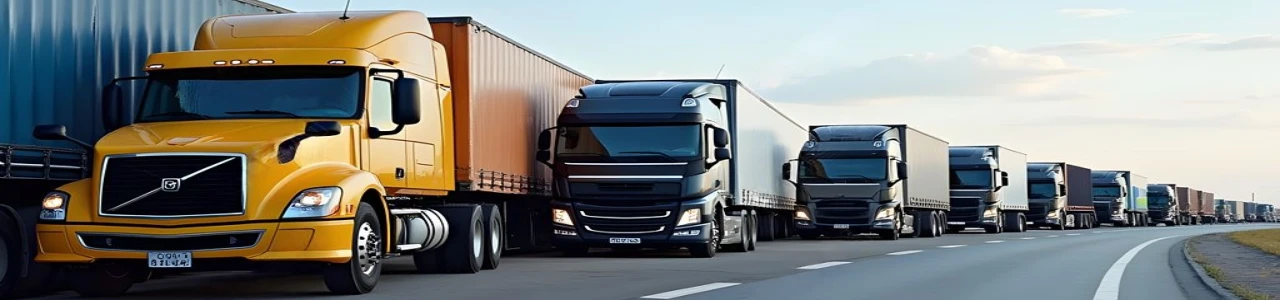
Aluminum alloy vans come in various side panel designs, including aluminum alloy skin + inner panel structures, and composite side panel structures combining aluminum alloy and fiber-reinforced composite materials. Due to their light weight, large loading space, attractive appearance, and the ability to print advertisements on their surfaces, they hold a leading position in markets worldwide.
The main aluminum alloy profiles used for containers include 6061, 6082, 6351, 6005, 6063, and 6060, with 6061 and 6082 accounting for over 90%.
Refrigerated trucks are enclosed van-type transport vehicles used to transport frozen or fresh goods, including refrigerated bread trucks, refrigerated box trucks, and semi-trailer refrigerated trucks. As temperatures decrease, the strength and ductility of aluminum and aluminum alloys increase, making aluminum alloys ideal materials for cryogenic equipment.
Semi-trailers and RVs made of aluminum offer significant economic and social benefits. RVs are also a type of travel trailer. Reducing vehicle weight is the primary reason for choosing aluminum as the base material. The side panels and inner panels of the semi-trailer body are made of 4-5mm thick 5052 aluminum alloy, with flange thickness matching the panel thickness. The butt joints of the aluminum alloy panels are located at reinforcing ribs, and the upper and lower edges of the aluminum alloy panels are supported by the flanges of the upper and lower aluminum profile beams.
The livestock transport vehicle is prone to premature corrosion and damage due to the corrosion of livestock spray cooling water and livestock excreta. Therefore, the carriage is required to have good anti-corrosion performance. European and American livestock transport vehicles generally use aluminum alloy to make carriages, which generally include aluminum alloy sheet+column and aluminum profile+side wall.
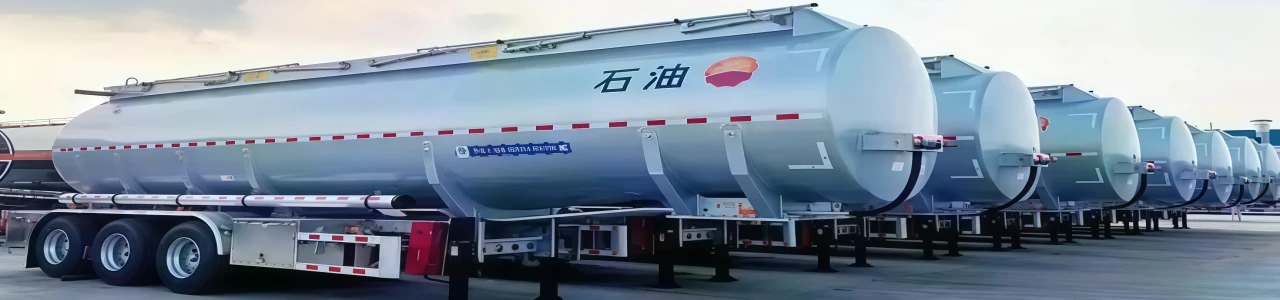
Compared to ordinary carbon steel and stainless steel tank trucks, aluminum alloy tank trucks not only significantly reduce vehicle weight and improve transportation efficiency, but also extend the service life of the tank. 5083, 5454, and 5182 are commonly used tank materials and can be used to load high-density materials such as petroleum, gasoline, chemical products, and cement.
|
Application Part |
Aluminum Alloy Grade | Material Condition | Thickness Range (mm) | Main Characteristics |
Application Advantages |
|
Tank Body |
5083 |
H111 |
5-8 |
High strength, excellent corrosion resistance, good weldability | Main load-bearing part of the tank, withstands various stresses during transport, ensures structural stability |
|
Tank Body |
5454 |
H111 |
5-8 |
Medium strength, good corrosion resistance, excellent weldability | Used by some manufacturers; Mg content 2.4%-3.0%, tensile strength >215 MPa |
|
Head/End Cap |
5182 |
– |
6 |
High elongation, tensile strength 280-350 MPa, good weldability | Designed specifically for European road dangerous goods transport protocols, excellent mechanical properties of welds |
|
Tank Cover/Lid |
5083 |
O-temper |
5-8 |
Good ductility, easy to bend and form | Softer O-temper is suitable for cover bending processes, ensuring sealing |
|
Baffle/Separation Plate |
5083 |
O-temper |
5-8 |
Good ductility, easy to form and process | Used in surge plate/wave breaker areas; O-temper facilitates processing, ensures structural integrity |
|
Baffle/Separation Plate |
5754 |
– |
5-8 |
Medium strength, excellent corrosion resistance, good weldability | Typical Al-Mg series alloy, used by some manufacturers |
|
Tank Body |
5052 |
– |
5-8 |
Excellent rust resistance, high strength and corrosion resistance | Widely used corrosion-resistant aluminum, excellent overall performance |
|
Tank Body |
6061 |
– |
5-8 |
Medium strength, good corrosion resistance, good weldability | Higher quench sensitivity, used in some special application scenarios |
|
Tank Body |
6082 |
– |
5-8 |
Can be heat-treated for strengthening, medium strength, good weldability | Can be heat-treated to enhance overall performance |

The bus body is all aluminum, and the top side beam of the bus is extruded with 6005A T6 alloy; 6061 T6 aluminum profile is adopted for rectangular aluminum tube of body frame; The chassis and main beam are made of 6082 T6 aluminum profiles.
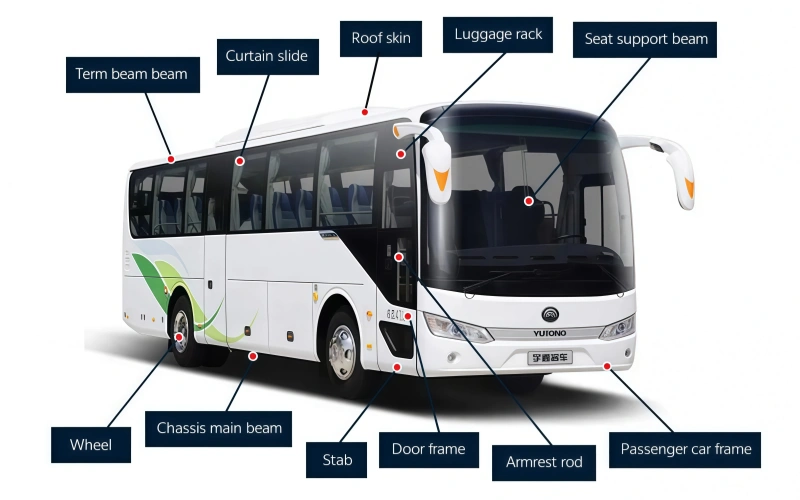
Aluminium profiles find wide use in passenger cars, with many types, including body structure, body covering and decorative parts.
The aluminium profile parts that were first applied to passenger cars mainly include floor layering, step layering, curtain slideway (channel profile), floor opening cover layering, ceiling layering (channel profile), ceiling layering (H-profile), vertical layering (angle profile), water flow striping (angle profile), interior/exterior trim strips, and side window trim cover profiles.
There are also some functional structural components, such as seat joist (channel profile), door frame, inner luggage rack, side window frame (channel profile), top grab bar chute aluminum profile, air circulation duct in the vehicle, etc.
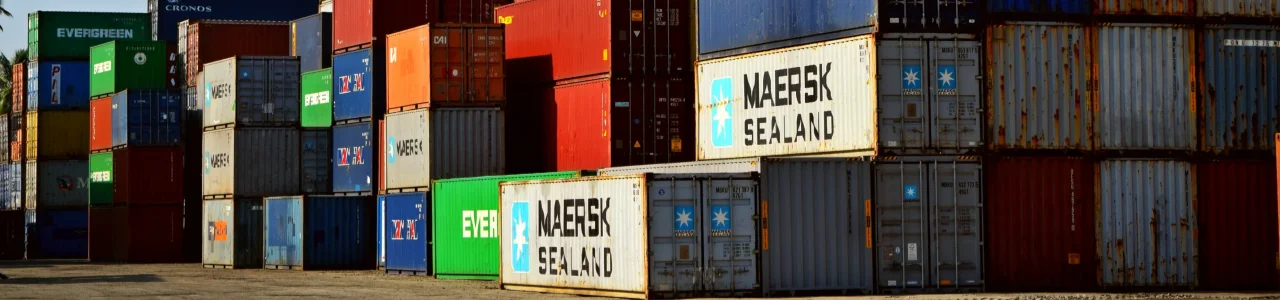
Aluminum profiles and sheets are finding increasing use. This is not only in manufacturing refrigerated containers. They also offer numerous advantages. These include ease of processing and light weight. This is in the manufacture of dry cargo containers. Such containers require complex ventilation channels.
Currently, the main components of aluminum containers typically utilize suitable aluminum alloy profiles and sheets.
Aluminum profiles are mainly used for components. These include container floors and connectors. They also include forklift rails and bottom support beams. Other uses are fixing beams for side aluminum panels. Door frames are another application. They primarily use 6061, 6082, 6063, and 6060 aluminum alloys. These are in T6 temper profiles. 6061 and 6082 alloys account for over 90% of the usage.
Aluminum profiles have very strict requirements regarding alloy composition, dimensional accuracy, internal structure, and properties to meet high-quality welding and assembly requirements. Generally, a container of a certain size uses 15-20 aluminum profiles of different cross-sectional specifications.
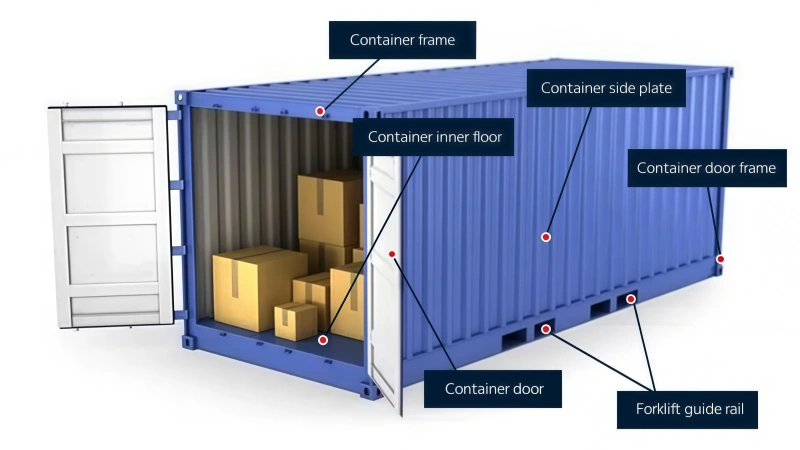
The side and top plates of aluminum containers mostly use 5052 aluminum alloy plates, which have good weldability and corrosion resistance. The choice of different thicknesses and widths of aluminum plates depends on different container types and performance requirements. Commonly used aluminum plate thicknesses are 0.8 mm, 0.9 mm, 1.27 mm, 1.4 mm, 1.6 mm, and 2 mm, and widths are 1040 mm, 1250 mm, 226 mm, 2340 mm, and 2500 mm.
HSTF is a leading manufacturer and supplier of aluminum alloys for transportation industry in China. We specialize in the production, processing, and trading of aluminum alloy. With over 18 years of experience in the aluminum industry, we can provide a full range of high-quality aluminum at competitive prices.
Our experienced team of engineers and technicians can customize extruded and rolled aluminum materials to your specifications, including standard sizes and custom aluminum material solutions.